
Picture this: you land after a long flight, walk straight past the baggage carousel, and head out of the airport while everyone else is still waiting for their suitcases. That is the whole payoff of packing a carry on for a week long trip — no lost luggage, no checked-bag fees, and nothing slowing you down between the plane and your plans. It sounds impossible until you realise a week of clothes is far less bulk than most people think, once you stop packing for every imaginary scenario and start packing for the trip you actually have.
The trick is not a smaller bag or a stricter personality. It is a simple system: a capsule wardrobe that mixes and matches, a packing method that uses every corner of the case, and a liquids kit that sails through security. Follow the steps below and a standard carry-on will hold seven days of outfits with room to spare.
First, Know Your Bag’s Limits
Before you pack a single shirt, check your airline’s carry-on size and weight limits — they are not universal. Many US airlines allow a bag around 22 x 14 x 9 inches, but budget carriers and international airlines are often stricter, and some enforce weight limits too. Measure your bag including wheels and handles, weigh it once packed, and keep a small personal item (a backpack or tote) for the overflow: laptop, book, snacks, and anything you will want during the flight.
Pack for the weather you will actually meet, not the weather you fear. Check the forecast for your destination a day or two before you leave, and build your wardrobe around it. One versatile jacket beats three “just in case” layers, and layers you can add or remove will cover a wider temperature range than a single heavy coat.
Build a 7-Day Capsule Wardrobe
A week of outfits does not mean seven separate outfits. It means a small set of pieces that all work together. Pick one neutral colour family — navy, grey, black, or olive — and make sure every top goes with every bottom. That one rule alone can cut your packing in half.
A solid starting point for seven days:
- 4–5 tops (a mix of T-shirts and one smarter shirt or blouse)
- 2 bottoms (one pair of trousers, one pair of jeans or a skirt)
- 1 dress or smart outfit, if your trip calls for one
- 7 sets of underwear and socks
- 1 light jacket or layer
- 1 pair of comfortable walking shoes, worn on the plane
- 1 extra pair of shoes only if you truly need them — shoes are the biggest space thieves in any bag
Wear your bulkiest items on the plane: the jacket, the jeans, the walking shoes. Your bag then only has to hold the lighter layers. When it comes to choosing what to wear on long travel days, comfortable travel pants that hold up on long days are worth their space, because a pair that stays comfortable from airport to evening saves you packing a second option.
Rolling, Folding, and Packing Cubes
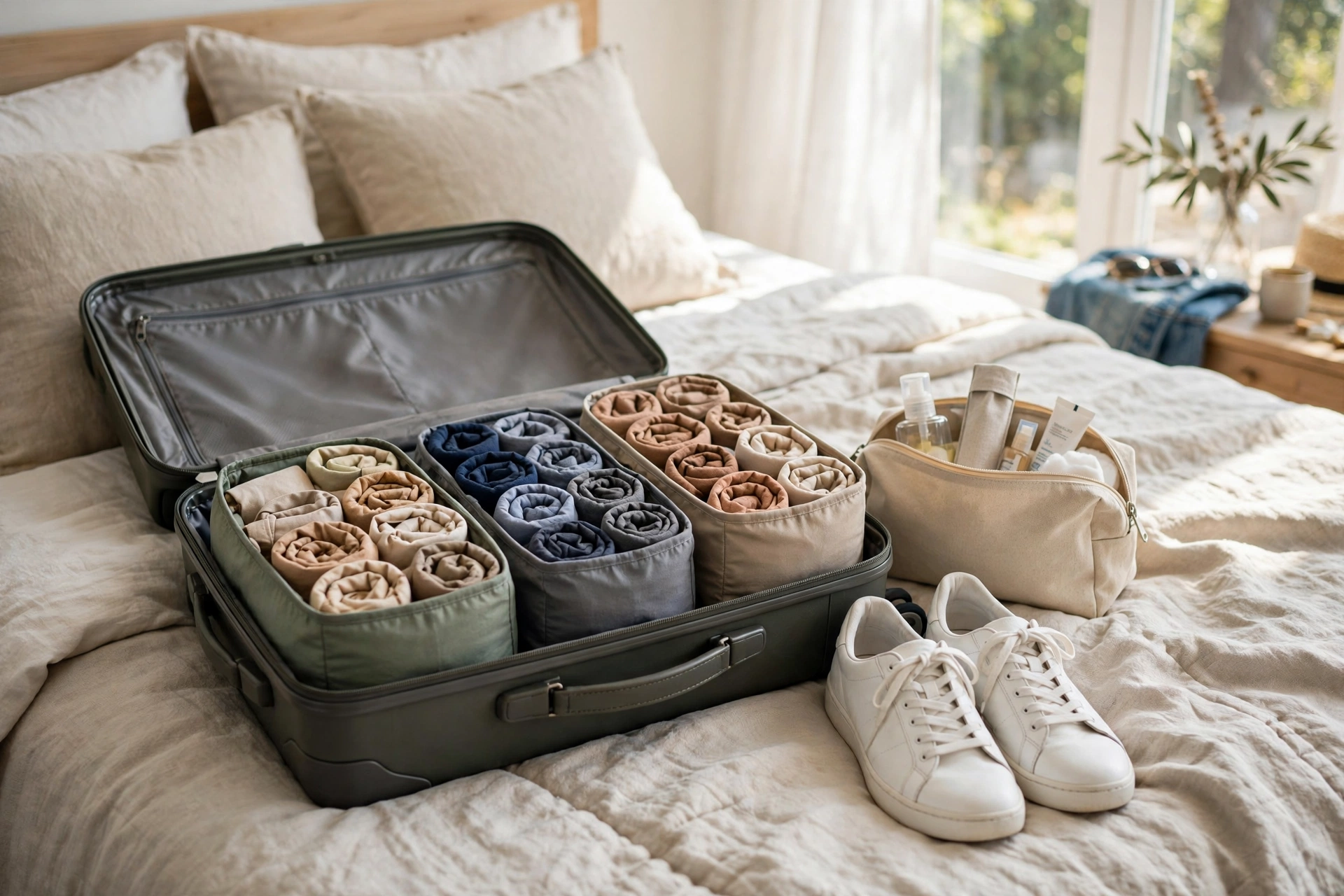
There is no single “best” packing method — the best method is the one that fits your clothes. Rolling works well for T-shirts, knitwear, and casual clothes: it squeezes out air and lets you see everything at a glance. Folding works better for shirts and anything that creases easily; fold them around a flat item, like a packing cube, to keep the edges from digging in.
Packing cubes earn their keep on a week-long trip. Use one cube per category — tops, bottoms, underwear — and you can pull out exactly what you need without unpacking the whole bag in a hotel room. Pack in this order: heavy items at the bottom near the wheels, rolled clothes in the middle, and anything you will need first on top.
Stuff small things into dead space: socks inside shoes, chargers inside a shoe bag, a belt coiled around the edge of a cube. A carry-on has more usable space than it looks like — most of it is lost to air gaps, not clothes.
Toiletries and the Liquids Rule
For flights in the US, the TSA’s 3-1-1 rule applies to carry-on liquids: each container must hold 3.4 ounces (100 ml) or less, all containers must fit in one clear quart-size bag, and each passenger gets one bag. The limit is judged by the size of the container, not how much is left inside — a half-empty large bottle will still be taken. Decant what you need into travel-size bottles, or switch to solid versions: shampoo bars, bar soap, and stick deodorant do not count against the liquids limit at all.
Keep the liquids bag at the top of your case or in an outer pocket so you can pull it out at security without a repack. And remember that rules differ by country, so if you are flying internationally, check the rules for each airport on your route before you pack.
Tech, Documents, and the Personal Item
Your personal item is your second bag — use it well. Keep your passport and ID, phone and charger, headphones, medication, a change of underwear, and anything valuable in it, never in the carry-on you might be asked to gate-check on a full flight. Medication should always travel with you in the cabin, along with a copy of any prescription you may need.
Chargers, cables, and adapters tangle fast, so keep them in one small pouch. Download offline maps, boarding passes, and hotel confirmations before you leave, so a dead airport Wi-Fi connection never strands you.
What Not to Pack
The most common carry-on mistake is packing for fear: the extra sweater for a cold snap that never comes, the third pair of shoes, the book you will never open. Be honest about what you will actually wear and use. Most destinations have shops, laundries, and pharmacies — almost anything you forget can be bought, and almost everything you overpack will come home unworn.
Skip the checked-bag fee and you save more than money: skipping the carousel also saves the anxious wait and the risk of a bag going astray. As part of planning a vacation without breaking the bank, travelling with only a carry-on is one of the easiest costs to cut, and it pays off on every single trip.
Your Carry-On Checklist for a Week
- Carry-on bag within your airline’s size and weight limits
- 4–5 mix-and-match tops, 2 bottoms, 7 sets of underwear and socks
- 1 jacket or layer, worn on the plane with your bulkiest shoes
- Packing cubes, one per clothing category
- Liquids bag: containers 3.4 oz (100 ml) or smaller, one quart-size bag
- Toiletries, solid alternatives where possible
- Personal item with passport, medication, chargers, and valuables
- Laundry bag for worn clothes, so clean and dirty never mix
Frequently Asked Questions
Can you really fit a week’s clothes in a carry-on?
Yes, with a capsule wardrobe where every piece matches. Seven days needs roughly four or five tops and two bottoms, not seven full outfits, plus a plan to re-wear. If your trip includes a formal event or extreme weather, it gets harder — but for a normal week of sightseeing, city breaks, or visiting family, one carry-on is genuinely enough.
What about winter trips?
Winter is the hardest test, because coats and knitwear are bulky. Wear the coat on the plane, pack thin thermal layers instead of thick jumpers, and choose one pair of warm, waterproof boots as your worn shoes. If you still cannot fit everything, a laundry stop mid-trip beats a checked bag.
Should I do laundry during the trip?
For trips longer than a week, yes — and even on a seven-day trip, one mid-week laundry run lets you pack half as much. Many hotels offer laundry services, and a sink wash of underwear and T-shirts overnight can stretch a small wardrobe a long way.
Final Thoughts
Packing a carry on for a week long trip is a skill, and like any skill it gets easier every time you do it. Start with the capsule wardrobe, roll what rolls and fold what creases, keep your liquids bag accessible, and leave the “just in case” items at home. You will walk off the plane lighter, faster, and with one less thing to worry about — and that is a better way to start any trip.