
Stand in the main square of a Mexican colonial town as church bells ring, the smell of street food drifting from a market stall, and a mariachi band tuning up nearby, and you will understand why Mexico rewards travellers who look beyond the beach resorts. This list of places to visit in Mexico covers the country’s great historic cities, its coastlines and its natural wonders, so you can build a trip that mixes culture, food and outdoor adventure.
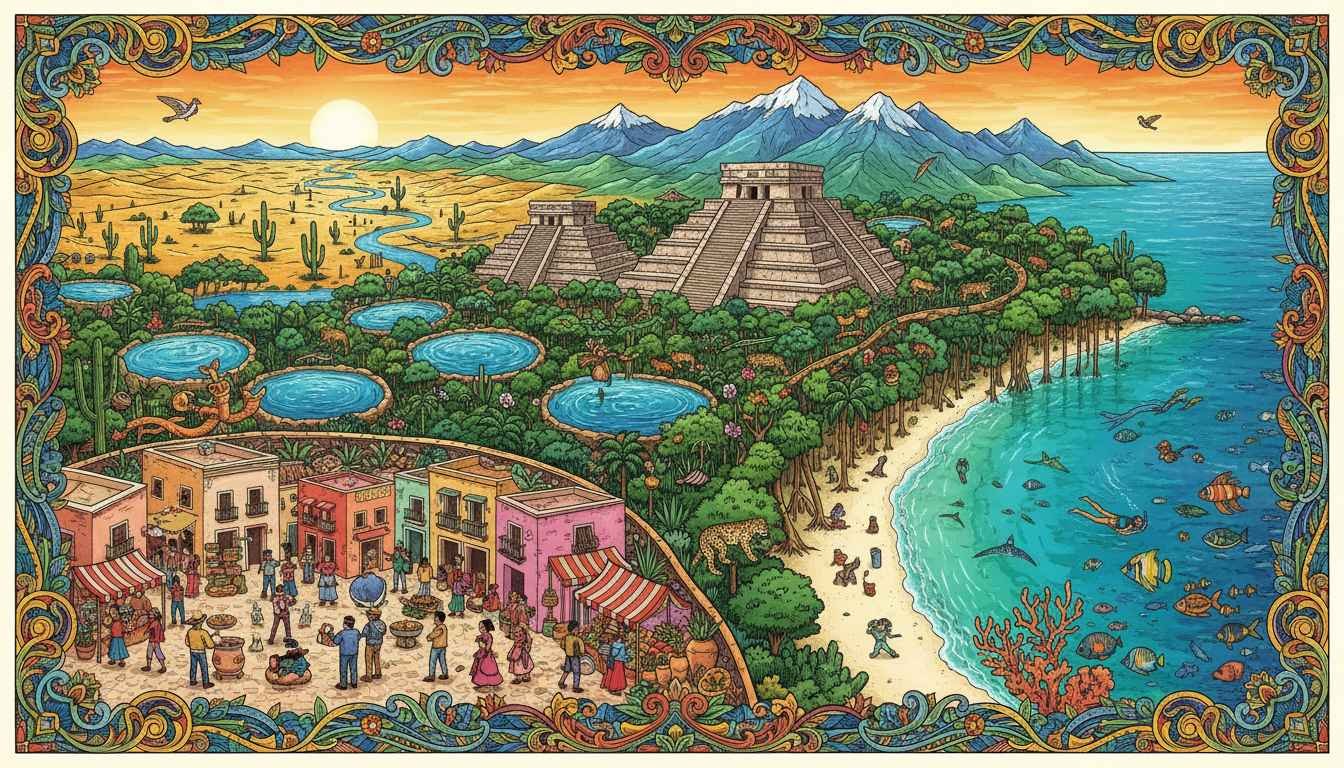
Historic Cities: Mexico City, Oaxaca and Guanajuato
Start in Mexico City, one of the world’s largest and most layered capitals. Its historic centre, a UNESCO World Heritage site, holds the Metropolitan Cathedral, the National Palace and the Templo Mayor, the remains of the Aztec capital Tenochtitlan, while the nearby National Museum of Anthropology is one of the world’s great museums of ancient civilisations. The city’s neighbourhoods each have their own character, from the bohemian streets of Coyoacán, home to the Frida Kahlo Museum, to the canals of Xochimilco, where trajineras, colourful flat-bottomed boats, carry visitors past floating gardens.
South of the capital, Oaxaca City is Mexico’s culinary heart, famous for its mole sauces, its markets and its crafts, and for the nearby archaeological site of Monte Albán, a Zapotec hilltop city with panoramic views. Guanajuato, a UNESCO-listed colonial city in the central highlands, is a maze of colourful houses, underground tunnels and steep alleyways, with the famous Callejón del Beso, the Alley of the Kiss, and a lively university atmosphere. San Miguel de Allende, also a UNESCO World Heritage site, is smaller and more polished, known for its pink parish church, its art galleries and its rooftop restaurants.
Colonial Towns and Culture: Puebla and San Miguel de Allende
Puebla, east of Mexico City, is known for its Talavera pottery, its baroque churches and its mole poblano, the rich sauce said to have been created in its convents. Its historic centre, with tiled facades and a grand cathedral, is best explored on foot over a day, with a stop at the Palafoxiana Library, one of the oldest public libraries in the Americas. These colonial towns reward slow travel: a morning in the markets, an afternoon in the churches and museums, and an evening in the main square, where families gather and street vendors sell local specialities.
Beaches and Coast: Cancún, Tulum and the Baja Peninsula
Mexico’s Caribbean coast, in the state of Quintana Roo, offers the country’s most famous beaches. Cancún, with its hotel zone and turquoise water, suits visitors who want resort comfort and easy access to day trips, while Tulum, further south, combines a clifftop Maya ruin overlooking the sea with a quieter, more bohemian beach scene and nearby cenotes, natural sinkholes filled with clear water that are perfect for swimming. Playa del Carmen, between the two, offers a lively pedestrian avenue and ferry access to the island of Cozumel, known for its diving and snorkelling. On the Pacific side, the Baja California Peninsula offers a different coast: desert landscapes, whale-watching in season, and the surf towns of the Pacific, with a wilder, less built-up feel than the Caribbean resorts.
Natural Landscapes: Copper Canyon, Cenotes and Monarch Butterflies
For nature, Mexico is hard to beat. Copper Canyon, in the state of Chihuahua, is a network of canyons larger and deeper than the Grand Canyon in places, best seen from the Chihuahua al Pacífico railway, which crosses bridges and tunnels through dramatic mountain scenery. The Yucatán Peninsula’s cenotes, formed when limestone collapsed into underground rivers, are among the country’s most distinctive swimming spots, with the sacred cenote at Chichén Itzá and the open cenotes near Valladolid among the best known. In winter, the Monarch Butterfly Biosphere Reserve in Michoacán hosts millions of monarch butterflies that migrate from North America, a spectacle best seen on a guided visit with local guides who protect the reserve. The Chiapas rainforest, in the south, adds waterfalls, Maya ruins such as Palenque, and the Sumidero Canyon, a deep river gorge best seen by boat.
Ancient Sites: Chichén Itzá, Teotihuacán and Palenque
No list of places to visit in Mexico is complete without its ancient sites. Chichén Itzá, on the Yucatán Peninsula, is the most famous Maya city, with its great pyramid, El Castillo, its ball court and its sacred cenote; arrive early to avoid the crowds and the midday heat. Teotihuacán, just outside Mexico City, is an earlier and larger city, with its Pyramids of the Sun and Moon and its Avenue of the Dead, and is an easy day trip from the capital. Palenque, in the Chiapas jungle, is smaller and more atmospheric, with temples and tombs set among trees and waterfalls. At all three, hiring a licensed local guide adds far more than a guidebook: the history, the astronomy and the daily life of these cities come alive with a good storyteller.
Planning Your Trip: When to Go and How to Travel
The best time to visit most of Mexico is the dry season, roughly November to April, when the weather is warm and settled across most regions, though the highlands can be cool in the evenings. The rainy season, from May to October, brings afternoon showers and greener landscapes, and is also the season for the monarch butterflies’ arrival in late autumn. Mexico is large, so internal flights save time between regions, while buses are comfortable and affordable for shorter distances. For food, follow the locals: market stalls and small family restaurants usually offer better and cheaper meals than hotel restaurants. For more coastal and island travel ideas, see our guides to the Martha’s Vineyard best places to visit and the places to visit in San Pedro, Belize.
FAQ: Frequently Asked Questions About the List of Places to Visit in Mexico
- How many days do you need in Mexico?
Ten days cover Mexico City and one other region well; two to three weeks let you combine the capital, a colonial city, a beach and an ancient site without rushing.
- What is the best time to visit Mexico?
November to April, the dry season, offers the most reliable weather for sightseeing across most regions.
- Is Mexico suitable for families?
Yes — the beaches, cenotes, museums and archaeological sites all suit children, with resort areas and guided tours making family travel straightforward.
Final Thoughts
Mexico is not one destination but many: a great capital, colonial towns, Caribbean beaches, deep canyons and ancient cities. Pick one historic city, one coast and one natural wonder for your first trip, and you will leave already planning the second.