
# How to Travel With Medication Safely Abroad
You are standing at the airport, passport in hand, when a small worry surfaces: did you pack your medicine the right way? It is in your suitcase somewhere, you think — but which bag, and will it survive the flight, the customs line, and a week of different time zones? For many travelers, medication is the one thing that cannot simply be replaced at the nearest shop, so a little preparation before departure makes the whole trip calmer.
Traveling with medication safely abroad is less about special tricks and more about doing ordinary things carefully: keeping medicine identifiable, keeping it with you, and checking the destination’s rules before you leave.
Start Before You Pack: Check the Rules of Your Destination
The most important thing to understand is that a medicine that is perfectly ordinary at home may be regulated, restricted, or even treated as a controlled substance somewhere else. Each country sets its own laws, so there is no single international list you can rely on. The U.S. Centers for Disease Control and Prevention advises travelers to check with the destination country’s embassy — and with the embassies of any countries where you have a layover — to make sure their medicines are permitted there.
Do that check several weeks before departure, not the night before you fly. If a medicine is not allowed, or needs extra paperwork, you will need time to discuss alternatives or obtain a letter or permit. Many countries allow a limited personal supply, often around a month’s supply, but amount and paperwork vary — treat any general figure as a starting point, not a guarantee.
When you check, use the generic name of each medicine, not only the brand name. Brand names change from country to country, while the generic name travels with you and is what pharmacists and officials are most likely to recognize. Make a list before you travel: generic name, brand name, dose, how often you take it, and the total quantity you are carrying.
For more detail on this step, see the CDC’s guidance on traveling abroad with medicine, which covers embassy checks, controlled substances, and what to do if a medicine is not permitted at your destination.
Build Your Medication Travel Kit
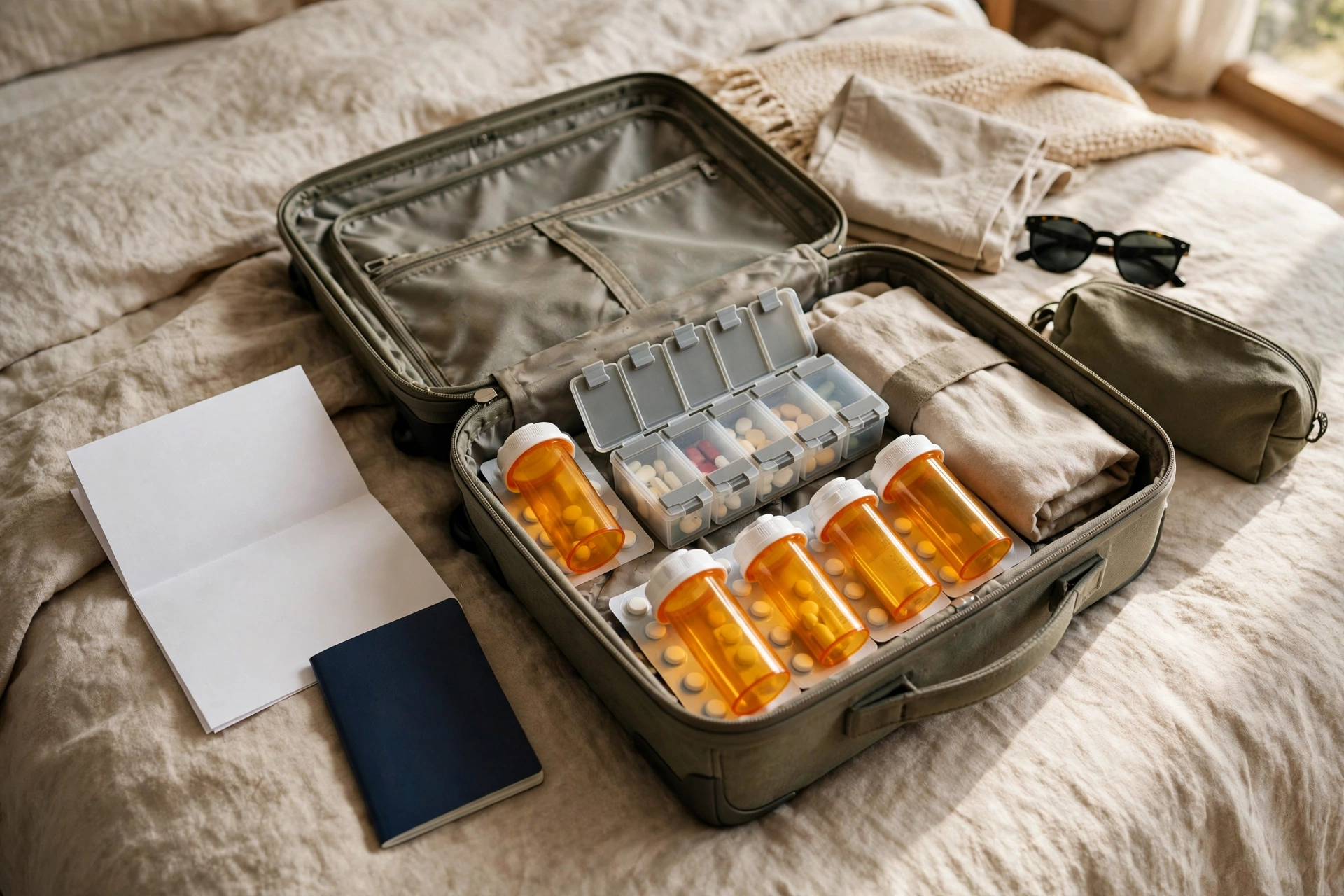
Think of your medication kit as one small, self-contained unit that never leaves your side. It should contain:
- Every medicine you need for the whole trip, plus extra for delays — a few days’ surplus is a sensible buffer if a flight is cancelled or a journey runs long.
- Each medicine in its original, labeled container, with your full name, the medicine name, and the dose clearly visible. Do not decant everything into an unmarked pill organizer before an international flight; an unmarked container is much harder to explain at a checkpoint.
- Copies of your prescriptions, including generic names, and a doctor’s letter if you use a controlled medicine, an injectable medicine, or a medicine that needs special equipment. The letter should state your condition in general terms, the medicines, their doses, and the quantity you are carrying.
- A second copy of your prescriptions and the doctor’s letter stored separately — for example, a photo on your phone and a paper copy in a different bag — so losing one copy does not leave you with nothing.
- Anything the medicine needs to work: inhaler spacers, injection pens, glucose-monitoring supplies, or a cool bag if a medicine must stay refrigerated.
Leave one copy of your prescription list at home with a trusted person, so losing your documents abroad does not leave you without the details.
Pack Medication in Your Carry-On the Right Way
Always pack all of your medication in your carry-on bag, never in checked luggage. Checked bags can be delayed, lost, or exposed to temperature extremes in the cargo hold, and any of those problems becomes serious when the bag holds something you need every day. Keeping medicine in the bag that stays with you also means you can show it, with its labels and paperwork, if an official asks.
Within your carry-on, keep the medication kit together and easy to reach — not buried under clothes at the bottom of the bag. If you are asked about it at security, you can present the whole kit at once instead of searching through your luggage in a queue. Liquid medicines and cooling packs have their own security rules, which differ by airport, so check your departure airport’s guidance before you travel and be ready to declare liquid medicine at the checkpoint if asked.
For the wider packing picture, see how to pack a carry-on for a week-long trip — the same discipline of keeping essentials accessible and organized applies directly to your medication kit.
Handling Time Zones, Storage, and Daily Doses
Crossing time zones complicates a regular dosing schedule. Before you travel, ask your prescriber or pharmacist how to handle the change: in general, medicines are taken according to the time since your last dose rather than the local clock, but the right adjustment depends on the medicine, so get advice for your own prescription rather than guessing. Set phone alarms in the new time zone once you arrive, and keep a note of when you last took each dose during the journey itself, when tiredness makes it easy to lose track.
Storage matters just as much. Heat, humidity, and direct sunlight can reduce the effectiveness of many medicines, so do not leave them in a hot car, on a sunny windowsill, or in a bag left in the sun. If a medicine needs refrigeration, plan the cold chain in advance: a small insulated bag with a frozen gel pack for the flight, and a hotel fridge on arrival — and confirm the fridge will actually be available before you rely on it. If you are unsure whether a medicine needs special storage, your pharmacist can confirm it in a minute, and that minute is worth taking.
Finally, do not buy replacement medicine abroad without checking it first. Names, strengths, and ingredients can differ between countries, and counterfeit medicines are a real problem in some places. Use a licensed pharmacy and ask the pharmacist to confirm the match.
If Something Goes Wrong Abroad
Even with careful packing, things can go wrong: a bag is delayed, a bottle is dropped, or a trip runs longer than planned. Having your prescription copies and doctor’s letter ready turns a stressful situation into a manageable pharmacy visit. Go to a licensed pharmacy first for a straightforward refill question, and seek local medical care if you need a new prescription or if a medicine has been lost entirely — a local clinician can assess you and prescribe an equivalent where one exists.
Check before departure whether your travel insurance covers medical care abroad, including new prescriptions, and keep receipts for any care or medicines you buy.
Frequently Asked Questions
Can I put my medication in checked luggage if my carry-on is full?
It is much safer not to. Checked luggage can be delayed or lost, and you may need the medicine before the bag catches up with you. If space is tight, repack other items rather than your medication kit, and keep the kit in the bag that stays with you.
Do I need a doctor’s letter for every medicine?
Not necessarily for an ordinary prescription in its labeled container, but a letter is strongly advisable for controlled medicines, injectables, and any medicine that needs special equipment. When in doubt, a short letter costs little and can save a long conversation at a border.
What if my medicine is not allowed in my destination country?
Do not try to carry it in anyway. Talk to your healthcare provider well before departure about an alternative that is permitted there, or about the permit or documentation the destination requires. The destination embassy is the right place to confirm what is actually needed.
Final Thoughts
Traveling with medication safely abroad comes down to three habits: check the destination’s rules early, keep every medicine labeled and in your carry-on, and carry the paperwork that proves the medicine is yours and prescribed for you. Do those three things, add a few days’ surplus and a plan for time zones and storage, and your medication stops being a source of worry — leaving you free to enjoy the trip itself.